
Rebuilding Connection – Part 1
Why People Are Turning to GenAI for Their Most Vulnerable Needs

Many of us are turning to generative AI for emotional support. According to Harvard Business Review, ‘therapy/ companionship’ is the top use case for GenAI. Why? We’re facing a very real, unmet need: human connection.
We want to be listened to, understood, affirmed—and sometimes, we want good advice. But the people in our lives may not have the time, emotional capacity, or the skills to support us in the ways we need. And so, we turn to tools that feel accessible and responsive. For many, AI fills that gap.
But while AI may feel like a solution, it also raises a deeper question: what happens when we replace people with technology in our most vulnerable moments?
More Tech, Less Connection?
We don’t yet know how AI therapy and emotional support will play out over the next few years. But if history is any guide, the outlook is concerning.
Consider the impact of past technologies: social media, video games, even television. Each promised some degree of community and entertainment. Maybe they delivered on entertainment, but they also accelerated disconnection. How? Simply by taking the leisure time we used to spend in person and turning it into screen time. The 2023 U.S. Surgeon General’s Report on Our Epidemic of Loneliness and Isolation found that Americans now spend an average of six hours per day on digital media.
I worry AI may follow the same path, becoming a catalyst for even deeper isolation, from each other and from reality.
Does Spending Less Time Together Actually Matter?
According to the American Time Use Survey, the average time Americans spend with friends has dropped from 6.5 hours per week in 2003 to just 2.9 hours per week by 2020. In that same period, time spent alone has jumped from 5.9 to 8.3 hours per day (see image below for additional statistics). We are spending less time with each other and more time alone than ever before.
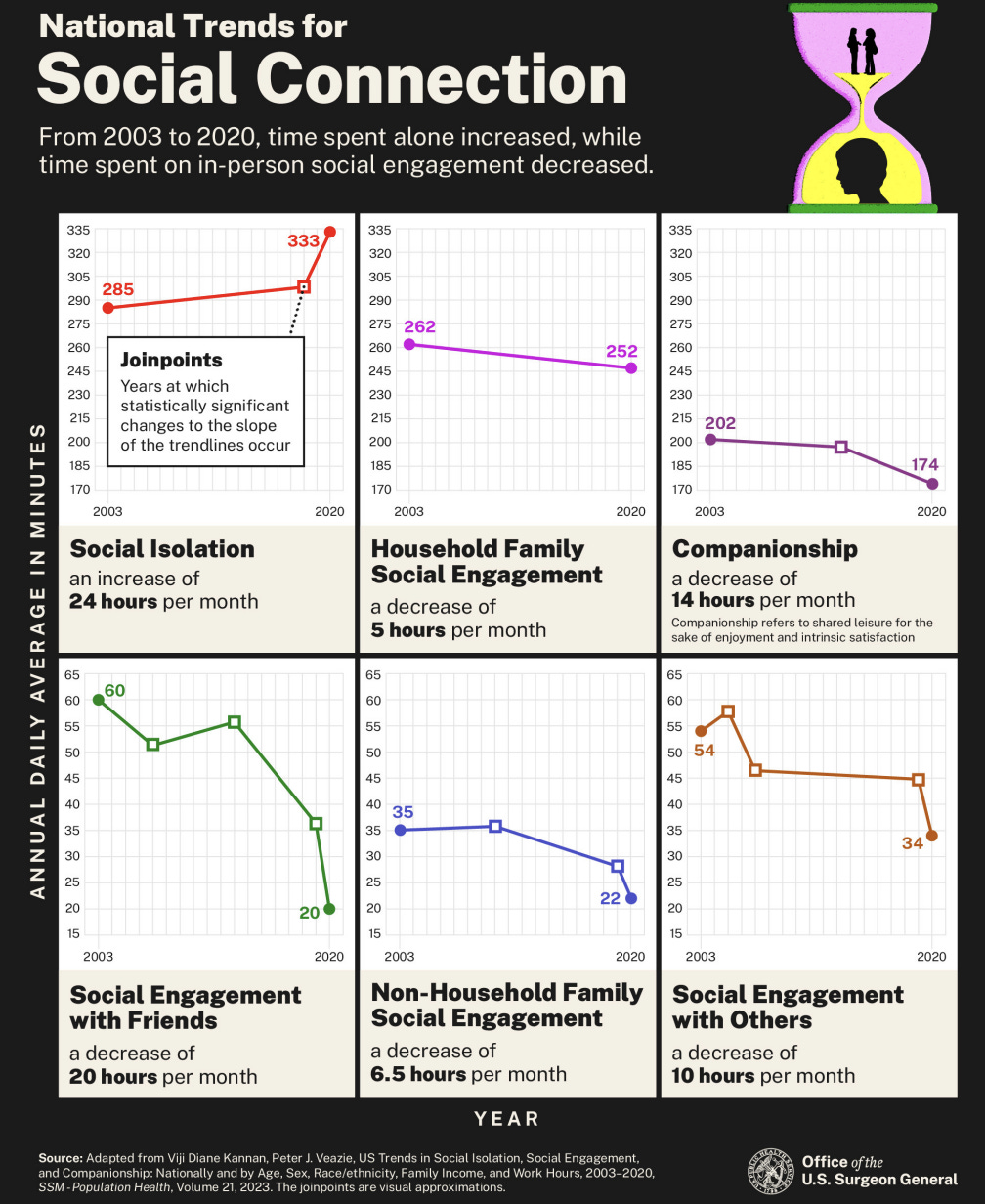
Does it matter?
Yes—it matters a lot.
Social connection is one of the strongest predictors of long-term health and well-being. In contrast, loneliness and isolation are linked to increased risks of chronic illness, depression, and premature death (Surgeon General’s Report, 2023).
One of my favorite lines comes from journalist Johann Hari, who famously said: “The opposite of addiction is connection.”
To illustrate this, consider psychologist Bruce Alexander’s famous Rat Park experiment. Two groups of rats were given the same access to drug-laced water: one group isolated in barren cages, the other in a rich, social environment called Rat Park. The isolated rats consumed far more of the drug. The social rats mostly avoided it.
Depression, anxiety, and addiction often point not to personal failure, but to a world that doesn’t meet our psychological and social needs.
In other words: feeling despair in an isolating world is a rational response.
And it’s not just about mental health. Connected people report greater educational attainment, higher job satisfaction, more financial stability, and deeper fulfillment (Surgeon General’s Report, 2023). Which leads to the next question…
How Did We Get Here?
In 2000, Harvard professor Robert Putnam explored the decline of social capital (the value we gain from relationships) in his influential book Bowling Alone. He highlighted several key trends:
Shifting Generational Values: During WWII, Americans rallied around a shared purpose. Today, collective clarity and leadership are harder to find. As a culture, we often prioritize individualism over the common good. (I struggle a bit with WWII nostalgia here—but I do think individualistic values, which long predate that era, have created a thorn in our side.)
Television and Electronic Entertainment: Passive, screen-based entertainment has displaced communal time. Instead of gathering with neighbors or participating in civic life (or just sitting on your porch more often), we now spend most of our leisure hours in front of screens. (Guilty 🙋 and working on it)
Suburban Sprawl: Built in part from white flight, suburban development often isolates us. We sit in cars, commute long distances, and trade walkable, diverse neighborhoods for strip malls and cul-de-sacs.
Time and Financial Pressure: Rising costs of living, long work hours, and demanding schedules leave little bandwidth to invest in relationships.
These are challenges no one person can solve alone. Do they mean we’re powerless? Absolutely not. But they do mean we need to treat disconnection not just as a personal issue, but a societal one.
Where Do We Go From Here?
We have a choice, as individuals and as a society: we can create communities that foster connection, making it easier to use AI (and other tools and substances) in healthy, supportive ways. Or we can continue down a path where more people feel isolated and turn to robots to meet their emotional needs.
The solution is multi-layered. Real change will require shifts in policy, culture, and infrastructure. But for those of us who can’t afford to wait—because disconnection is already harming our health—we need ways to rebuild connection now.
In the next post in this Rebuilding Connection series, I’ll share tangible ideas for how we can start doing just that.
References
Harvard Business Review. (2025). How People Are Really Using GenAI in 2025.
Hari, J. (2015). Everything You Think You Know About Addiction is Wrong [TED Talk]. YouTube.
Putnam, R. D. (2000). Bowling Alone: The Collapse and Revival of American Community. Simon & Schuster.
Alexander, B. K., Coambs, R. B., & Hadaway, P. F. (1978). The effect of housing and gender on morphine self-administration in rats. Psychopharmacology, 58(2), 175–179.
Hari, J. (2018). Lost Connections: Uncovering the Real Causes of Depression – and the Unexpected Solutions. Bloomsbury Publishing.
U.S. Bureau of Labor Statistics. (2020). American Time Use Survey. bls.gov.